Neighborhood Launches Bold New “Stray Cat Capture Economy,” Experts Call It the First Truly Profitable Local Industry
Residents of Maple Crest Estates have officially declared war on the neighborhood’s rapidly multiplying stray cat population—though “war” may be too gentle a word. What began as a few well‑meaning residents trapping and neutering cats “for the good of the community” has now evolved into a full‑blown entrepreneurial movement, complete with ransom posters, QR‑code payment links, and a surprising amount of community support.
The trend, dubbed Capture‑and‑Cash™, has swept through the neighborhood faster than a feral tabby spotting an unattended tuna can.
From TNR to TNRP: Trap, Neuter, Release… Pay
Traditionally, residents were encouraged to participate in TNR programs—Trap, Neuter, Release—under the belief that spending hundreds of dollars to sterilize animals they didn’t own was somehow a noble civic duty.
But locals have finally begun asking the important questions:
- Why am I paying to fix a cat that isn’t mine
- Why am I feeding it afterward like it’s a tiny, ungrateful roommate
- Why does it still hiss at me even though I bought it premium kibble
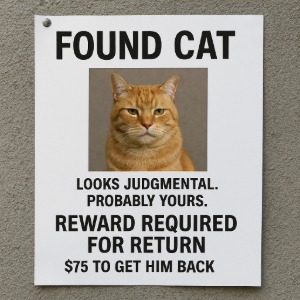
Now, instead of releasing the cats back into the wild (also known as “your freshly mulched flower bed”), residents are posting FOUND CAT – REWARD REQUIRED FOR RETURN flyers on every mailbox, lamppost, and HOA‑approved bulletin board.
One flyer reads:
“Found: Orange cat. Looks judgmental. Probably yours. $75 to get him back. Cash, Venmo, or Zelle.”
Neighbor Interviews Reveal Growing Frustration
“These cats didn’t just appear out of thin air.”
Local resident Janet, who is absolutely done with this nonsense, shared her thoughts:
“Cats don’t just magically appear and start claiming territory like tiny furry warlords. Someone bought them. Someone adopted them. Someone said, ‘Yes, this creature that screams at 3 a.m. is perfect for my home.’ And now it’s my problem? I don’t think so. You want your cat back—pay me money.”
Another neighbor, Rick, who has lost all patience and most of his begonias, added:
“We work hard to keep our yards clean. This is a no‑poop zone. These cats show up, stink up the place, and suddenly I’m supposed to feel bad for them? No. I’m feeling entrepreneurial.”
Late‑Night Cat Fights Push Residents Over the Edge
Perhaps the most passionate interview came from a resident who has reached the end of their sanity:
“Waking up at 1 a.m. or 3 a.m. to two stray cats going head‑to‑head over territory is not ok. First off, it’s my territory. I pay the mortgage. I mow the lawn. I take the trash out. They don’t get to square up like they’re in some feline UFC match outside my window. They need to go.”
He then added:
“If they want to fight, they can fight in someone else’s yard. Preferably the yard of whoever keeps feeding them.”
The Rise of the Cat Ransom Economy
Residents who once spent their weekends feeding strays and paying for neutering surgeries have discovered a far more satisfying hobby: profiting off the chaos.
One anonymous local (who insisted on being referred to only as “The Cat Bounty Hunter”) explained the new business model:
- Capture cat
- Take flattering photo
- Print poster
- Wait for emotional owner to panic
- Profit
“It’s basically DoorDash,” he said. “But instead of delivering food, I deliver your cat. And instead of a tip, I charge a mandatory $50 release fee.”
Stray Cat Feeders Outraged, Confused, Still Buying Cat Food
Meanwhile, the neighborhood’s dedicated stray‑cat feeders—those who have spent years leaving out bowls of expensive organic kibble for animals that don’t even like them—are reportedly “shocked and appalled” by the new trend.
One feeder, who asked to remain anonymous for fear of retaliation from both humans and cats, said:
“I spend $200 a month feeding these cats. I thought I was helping. Now people are making money off them? That’s not fair.”
When asked why she didn’t simply stop feeding them, she stared into the distance and whispered:
“They know where I live.”
Experts Predict a Booming Future
Local economists (who have never been this excited about anything) say the new cat‑ransom industry could become the neighborhood’s most profitable venture since the Great Garage Sale of 2019.
They estimate:
- $50–$150 per cat depending on fluffiness
- Extra fees for cats that bite
- Premium charges for cats that pretend not to recognize their owners
One expert concluded:
“Honestly, this is the most efficient use of community resources we’ve ever seen. Instead of wasting money neutering cats, residents are finally monetizing them. It’s capitalism at its purest.”
Conclusion: The Neighborhood Has Spoken
The message is clear:
- If you love your cat, keep it indoors
- If you let it roam, prepare your wallet
- If you’re feeding strays, congratulations—you’re basically running a cat‑supply chain for someone else’s side hustle
And as one resident proudly declared while stapling another ransom flyer to a telephone pole:
“This is America. If life gives you stray cats, you turn them into revenue.”
About the Author



 Kelly
Kelly 

 Daniel L