“TikTok Announces New Feature That Automatically Posts Whatever You Regret Most”
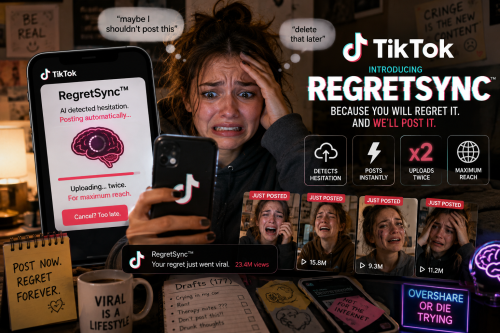
Menlo Park, CA — In a stunning leap forward for digital embarrassment, TikTok unveiled its newest feature: RegretSync™, an AI tool that detects moments of hesitation and immediately posts them before users can change their minds.
The company claims it’s “revolutionizing authenticity,” though critics say it’s just weaponizing impulsiveness. According to TikTok’s press release, RegretSync™ uses advanced algorithms to detect phrases like “maybe I shouldn’t post this” or “delete that later” — then uploads the video twice for “maximum reach.”
Social Media’s New Arms Race
Not to be outdone, other platforms are following suit:
- Instagram introduced “Insecurity Mode”, which automatically filters your face to look like someone more successful.
- Facebook launched “Memory Roulette”, randomly resurfacing posts from 2012 to remind users how bad their opinions used to be.
- X (formerly Twitter) announced “Auto‑Apology”, a feature that drafts public apologies before you even finish your tweet.
Experts Weigh In
Digital psychologists warn that RegretSync™ could lead to “chronic cringe fatigue,” a condition where users lose the ability to feel shame because they’ve already gone viral for it.
“It’s the logical next step,” said one researcher. “We’ve gone from sharing our highlights to broadcasting our breakdowns. Now the algorithm just skips the middleman.”
User Reactions
Early adopters are divided. One influencer praised the feature for “saving time,” saying,
“I used to spend hours deciding what to post. Now I just cry, and TikTok handles the rest.”
Meanwhile, privacy advocates discovered that RegretSync™ also syncs with users’ phone cameras, occasionally recording them while they’re thinking about posting — “to capture the raw emotion of indecision.”
The Future of Oversharing
TikTok confirmed plans to expand RegretSync™ into a full suite of tools, including:
- OverShare+ — automatically posts your drafts, screenshots, and therapy notes.
- TrendCoffin™ — buries your old trends with a fake funeral livestream.
- CloutInsurance™ — covers emotional damage caused by viral fame.
Despite backlash, the company insists the update is “for the culture.”
“We’re not just a platform,” said a spokesperson. “We’re a mirror — and we’re making sure you can’t look away.”
About the Author


 Daniel L

 Kelly
Kelly