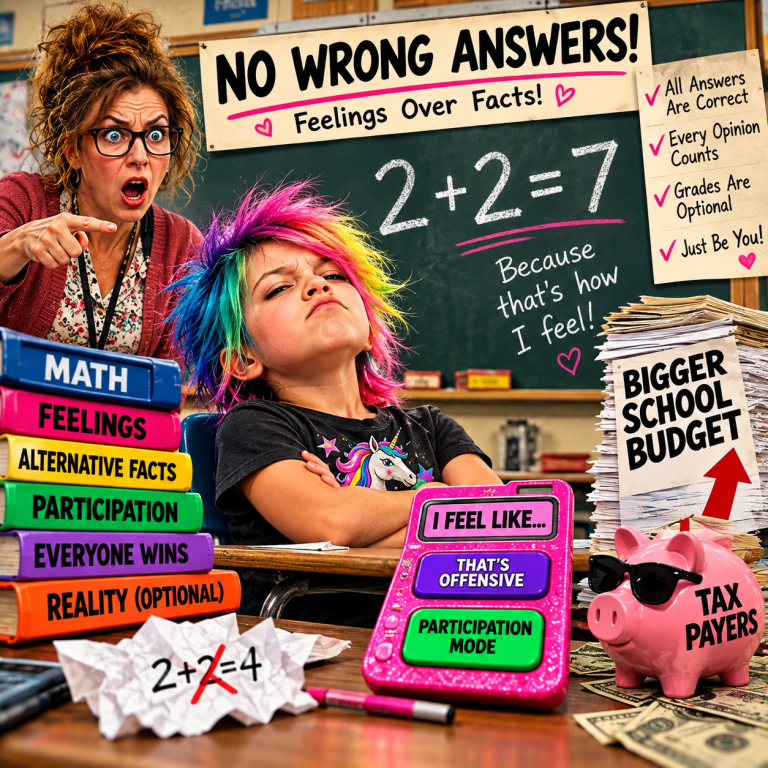
BREAKING: Schools Eliminate Wrong Answers After Students Report Math Is Hurting Their Feelings
New education policy allows 2 + 2 to equal 7 if the student feels strongly enough about it. Taxpayers now wondering whether school budgets should come with report cards.
UNITED STATES — In a groundbreaking victory for educational progress, a coalition of school administrators has announced that wrong answers will officially be eliminated from classrooms after researchers discovered that being told you’re incorrect can cause students to experience the devastating psychological condition known as having to try again.
Under the new initiative, called No Feelings Left Behind, teachers will no longer be permitted to tell students that an answer is wrong.
Instead, educators must acknowledge that every answer represents a unique mathematical journey, even when that journey ends with a fifth grader confidently declaring that 6 × 8 equals a dinosaur.
“We’re moving away from the outdated belief that mathematics should produce consistent answers,” explained Superintendent Karen Feelgood, who reportedly holds three advanced degrees in educational leadership and still uses her fingers to calculate a restaurant tip.
“Who are we to tell a child that two plus two equals four? Perhaps four simply doesn’t align with their personal truth.”
When asked whether this approach might create problems for students entering the workforce, Feelgood replied, “That’s a problem for the workforce.”
Calculators Under Investigation for Refusing to Respect Students’ Feelings
The controversy began when a fourth-grade student entered 12 ÷ 3 into a calculator and became emotionally distressed when the device displayed the number four.
The student reportedly believed the answer should have been nine.
Rather than explain division, school officials launched an investigation into the calculator for displaying what they described as “aggressively traditional mathematical values.”
Texas Instruments has reportedly been asked, in this universe, to develop a more inclusive calculator featuring three new buttons:
- I FEEL LIKE: Allows students to select their preferred answer.
- THAT’S OFFENSIVE: Automatically deletes equations that challenge personal beliefs.
- PARTICIPATION MODE: Awards full credit before the student enters a number.
The district has also proposed replacing the equals sign with a question mark, explaining that the traditional symbol creates unrealistic expectations of certainty.
Teachers Ordered to Stop Using the Word “Wrong”
Under the guidelines, teachers must replace traditional academic feedback with approved phrases.
“Incorrect” becomes “an alternative intellectual destination.”
“Please show your work” becomes “share your mathematical feelings, if comfortable.”
And “You failed the test” becomes “you successfully participated in an assessment experience.”
One veteran mathematics teacher was reportedly placed on administrative leave after suggesting that students might benefit from memorizing multiplication tables.
“Memorization is an outdated practice,” explained a district consultant charging $450 an hour to explain why children should no longer be expected to remember anything.
“Why memorize multiplication when you can ask artificial intelligence and receive a beautifully formatted incorrect answer?”
Graduation Requirements Updated: Students Must Now Identify as Academically Successful
In another historic development, graduation requirements will no longer be determined by grades, attendance, literacy, or demonstrated knowledge.
Students must simply complete a form stating that they feel ready for adulthood.
One graduating senior reportedly received honors after submitting a handwritten statement reading:
“I am smart because I believe I am smart, and anybody who disagrees is being negative.”
The student was immediately offered an unpaid internship in government communications.
Employers have expressed concern about the possibility of hiring accountants who believe subtraction is optional, engineers who consider gravity a personal opinion, and electricians who feel that 240 volts should be negotiable.
Administrators dismissed these concerns.
“We’re preparing students for the world of tomorrow,” said Feelgood. “And tomorrow, everyone will have AI to do their thinking.”
School District Announces $400 Million Budget Increase to Fund New Program
Despite eliminating traditional testing requirements, the district has requested an additional $400 million in taxpayer funding.
The proposed budget includes $85 million for emotional-support calculators, $60 million for curriculum consultants, $45 million for participation trophies, and $30 million to redesign report cards so that every grade appears as an A.
Another $75 million has been allocated to administrative training seminars at luxury resorts, where officials will explore innovative methods of telling parents that everything is going wonderfully.
The remaining $105 million has been classified as “miscellaneous educational excellence.”
When asked to explain the expenses, district officials stated that questioning education funding demonstrates a dangerous lack of commitment to children.
Taxpayers Ask a Dangerous Question: Can We See the Results Before Writing Another Check?
The controversy has sparked a broader discussion about something apparently more offensive than getting a math problem wrong: asking how public money is being spent.
Parents and taxpayers are beginning to wonder why education funding discussions sometimes resemble an endless crowdfunding campaign.
The pitch is familiar:
“We need more money.”
What will it accomplish?
“Better education.”
How will success be measured?
“Please stop attacking education.”
What happened to the last increase?
“We need another increase to investigate that.”
In a rare moment of mathematical clarity, one taxpayer asked whether schools could demonstrate measurable improvements in reading, mathematics, graduation readiness, and classroom learning before requesting another round of funding.
District officials reportedly called an emergency meeting to determine whether the question constituted an act of numerical aggression.
A New Concept: Make School Budgets Show Their Work
As the next election approaches, the article’s taxpayers have proposed something radical: school funding proposals should come with evidence, transparent budgets, and measurable goals.
The idea borrows a concept once commonly taught in mathematics classrooms.
Show your work.
If students are expected to demonstrate how they reached an answer, perhaps public institutions can explain how they spent the money and what results followed.
Voters considering school-funding measures can ask what additional funds would pay for, what results are promised, how progress will be reported, and what happens if targets are missed.
Of course, some schools face genuine needs, and outcomes depend on more than budgets alone. But those details are precisely why transparent information matters.
The district immediately rejected the proposal, explaining that accountability could create unrealistic expectations of accountability.
Breaking: School Board Awards Itself an A+ for Effort
Following an emergency seven-hour meeting, the school board unanimously awarded itself an A+ for leadership, innovation, compassion, and successfully completing another fiscal year.
No student achievement data was presented.
No spending audit was discussed.
No measurable academic improvements were identified.
However, officials proudly announced that the district’s new logo was 37% more colorful.
The meeting concluded with the approval of another $12 million to study why public confidence in the education system continues to decline.
When a parent asked whether students would eventually be required to know that 2 + 2 equals 4, the superintendent smiled reassuringly.
“That depends,” she replied. “How much additional funding are you willing to provide?”
Dirt in a Bottle’s education department reminds readers that while math may now be optional, the tax bill is still calculated down to the penny.
About the Author


 Daniel L
 Kelly
Kelly