
FOLLOW‑UP: We Warned You About the Google Loophole — The Internet Is Just Now Catching Up
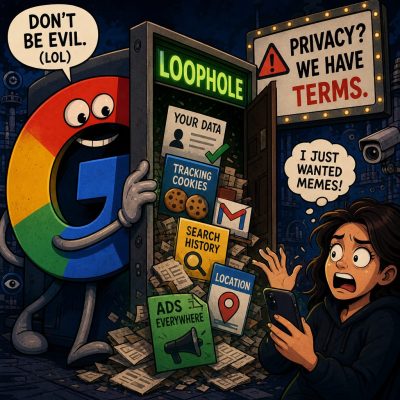
Weeks ago, we told you the truth: Google’s search bar can bypass every age‑verification law in the country.
We spelled it out. We diagrammed it. We practically gift‑wrapped it.
And now — now — the internet is suddenly acting like they’ve uncovered a national scandal because they typed “boobs” into Google Images and discovered the “Blur adult content” toggle.
Welcome to the party, everyone. The punch bowl is empty and the house is already on fire.
But here’s the part nobody is ready for:
That loophole was the easy one. There are worse ones. Much worse.
Let’s talk about the ones the internet still hasn’t figured out.
LOOPHOLE #1 (The One Everyone Just Discovered): Google Images Is the Real Adult Site
Adult sites get fined if they don’t verify your age.
Google?
Google can:
- Show explicit images
- Show previews
- Show thumbnails
- Show GIFs
- Show video stills
- Show links to adult sites
All without verifying anything.
And if it’s blurry? Settings → turn off “Blur adult content.”
Boom. Law defeated. Billions wasted. Lobbyists unfazed.
We told you this weeks ago. The internet is just now catching up.
LOOPHOLE #2: Chrome’s “Guest Mode” Is a Built‑In Parental Control Bypass
Parents think Guest Mode is safe.
It is not.
Guest Mode:
- Ignores SafeSearch
- Ignores parental controls
- Ignores age restrictions
- Ignores content filters
- Ignores account protections
- Ignores everything
It’s literally a burner browser built into Chrome.
Kids know this. Lawmakers don’t. Parents definitely don’t.
LOOPHOLE #3: Chrome Sync Re‑Enables Itself After Updates
This one is nasty.
Chrome Sync doesn’t just sync bookmarks. It syncs:
- Browsing history
- Autofill
- Saved addresses
- Saved phone numbers
- Saved payment methods
- Saved form entries
- Saved EVERYTHING
And here’s the kicker:
If you ever turned it on once — even years ago — Chrome updates can quietly re‑enable it “for your convenience.”
Your convenience = their data.
LOOPHOLE #4: Chrome Signs You In Even When You Swear You’re Signed Out
This is the one that makes people’s eyes widen.
Chrome has a long history of:
- Auto‑logging you in when you open Gmail
- Linking your browsing to your identity
- Syncing data even when sync is “off”
- Merging “signed out” activity with your real profile
You’re not anonymous. You’re Google‑anonymous, which is like being “invisible” while wearing a neon vest and ringing a cowbell.
LOOPHOLE #5: “Sign in with Google” Turns Every Website Into a Data Vacuum
This is the one nobody realizes until it’s too late.
Every site now has a “Sign in with Google” button.
Click it once — even by accident — and you’ve just:
- Verified your identity
- Linked your browsing
- Shared your email
- Shared your age
- Shared your profile photo
- Shared your Google metadata
- Given the site permission to ask Google for more
You didn’t “make an account.” You donated your identity.
You’re no longer “Billy making a burner account.” You’re Billy, Verified Human™, with a full data profile attached.
LOOPHOLE #6: Chrome’s “Incognito Mode” Isn’t Incognito — It’s Marketing
People think Incognito Mode hides them.
It doesn’t.
Incognito Mode:
- Hides nothing from your ISP
- Hides nothing from your employer
- Hides nothing from your school
- Hides nothing from Google
- Hides nothing from the websites you visit
- Hides nothing from trackers
- Hides nothing from fingerprinting
It only hides your history from your roommate.
That’s it. That’s the feature.
LOOPHOLE #7: Chrome’s “Privacy Sandbox” Is Just a Rebranded Tracking System
Google killed third‑party cookies. Everyone cheered.
Then Google replaced them with:
Topics API FLoC Ad personalization clusters Interest groups
It’s not “less tracking.” It’s centralized tracking.
Instead of 50 companies tracking you, now one company tracks you and sells the results to the other 49.
Dirt‑In‑A‑Bottle Takeaway
The internet is freaking out today because they discovered one loophole.
But we told you first. We hinted at it months ago and told you about it weeks ago. And we’re telling you again:
Chrome IS the loophole. Google IS the backdoor. The browser IS the problem. Uninstall it for your privacy and throw away your keyboard.
So here’s the real privacy advice:
- Stop typing your personal information
- Stop clicking “Sign in with Google”
- Stop trusting Chrome
- Stop assuming “signed out” means anything
- Stop pretending Google is a search engine — it’s a data refinery
The internet isn’t unsafe. Your browser is.
About the Author



 Jaime
Jaime 

 Kelly
Kelly