
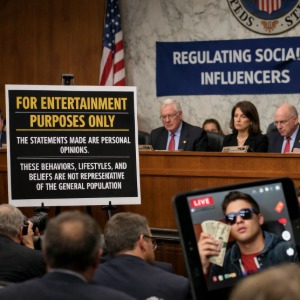
WASHINGTON, D.C. — A Senate subcommittee on digital consumer protection has advanced draft language for a bill that would require mandatory disclosure labels on all monetized social media content, citing what it describes as “widespread public confusion between performance, opinion, and reality.”
The proposal, currently circulating under the working title Online Content Transparency and Public Harm Reduction Act, would compel platforms such as TikTok, YouTube, Instagram, Facebook, and live-streaming services to display a standardized disclaimer on influencer content reading:
FOR ENTERTAINMENT PURPOSES ONLY
THE STATEMENTS MADE ARE PERSONAL OPINIONS
THESE BEHAVIORS, LIFESTYLES, AND BELIEFS ARE NOT REPRESENTATIVE OF THE GENERAL POPULATION
According to aides familiar with the draft, the language was intentionally “blunt enough to be understood by minors.”
Lawmakers Say the Problem Is No Longer Content, But Credibility
Committee findings attached to the bill describe a shift in how audiences interpret social media, noting that influencers are increasingly perceived as:
- economic role models
- cultural representatives
- moral authorities
- informal educators
Often simultaneously. Frequently without qualifications.
One internal summary states:
“A growing percentage of users, particularly minors, interpret monetized online performances as factual depictions of adulthood, success, and social consensus.”
The report avoids naming specific creators but references “content involving staged hardship, exaggerated wealth, performative outrage, and monetized personal crises.”
A Regulatory Model Borrowed From Music, Alcohol, and Gambling
The bill frames the labels as a consumer awareness measure, comparing them to Parental Advisory stickers on music, content ratings for films, and health warnings on tobacco products.
A senator involved in the drafting noted:
“We did not ban explicit music. We labeled it.
We did not ban alcohol. We labeled it.
We are not banning influencers. We are labeling them.”
The implication being that if an album once required a warning for words, then a livestream encouraging financial, emotional, or social decisions may require one for context.
Enforcement Through Fines, Not Content Removal
Unlike earlier regulatory efforts, the bill avoids bans or takedowns. Instead, it introduces revenue-based penalties.
Creators who fail to display the required label would be fined an amount equivalent to the earnings generated by the unlabeled content, plus additional administrative fees for repeat violations.
This provision has drawn particular attention due to its potential impact on creators who monetize narratives of hardship.
One example cited during committee discussion involved creators who solicit donations while presenting themselves as homeless or financially destitute, despite evidence of significant income or assets.
Under the proposed framework, such content would not be prohibited. It would simply be required to disclose that it is entertainment. Failure to do so would result in forfeiture of earnings.
A staff memo summarized the approach as:
“If it is performance, say so.
If it is reality, the label will not hurt.”
Influencer Community Responds With Immediate Alarm
Reaction from prominent creators has been swift, with many describing the proposal as an attack on free expression.
Several viral responses characterized the bill as “government narrative control,” despite the fact that the label explicitly states the views belong to the creator.
One influencer with millions of followers posted:
“This law tells people not to believe us.”
The clip was monetized and promoted.
Another warned that the bill would “destroy authenticity,” without clarifying how authenticity is harmed by admitting content is entertainment.
Label Culture Comes Full Circle
Critics of the influencer backlash have noted the irony.
For years, social media discourse has pushed aggressively for labels:
- content warnings
- trigger warnings
- disclaimers
- tone indicators
- contextual framing
The current proposal does not remove content or restrict speech. It simply adds context to the speaker.
A former regulator interviewed anonymously stated:
“The resistance seems strongest where the business model relies on the assumption that the audience believes this is normal life.”
Public Reaction Appears Divided, Quietly Relieved
While influencers dominate headlines, public response has been muted but supportive.
Comments gathered from online forums reflect fatigue rather than outrage.
@ParentOfTeens:
“If this helps my kid understand TikTok isn’t a career plan, fine.”
@FormerEducator:
“We’ve been competing with YouTube for years.
At least this admits it’s entertainment.”
@LivestreamSkeptic:
“So basically a warning label for nonsense.
Long overdue.”
A Bill That Assumes the Obvious Out Loud
Supporters argue the bill addresses a simple but uncomfortable truth.
The internet has blurred the line between:
- opinion and fact
- performance and reality
- popularity and credibility
Children, they argue, should not be expected to decode that distinction alone.
If labels can exist for movies, music, gambling, alcohol, and pharmaceuticals, then applying one to monetized influence is not radical.
It is corrective.
Even if it offends the people who benefit most from the confusion.
About the Author

 Jaime
Jaime 
 Kelly
Kelly