
Congress Quietly Launches Tax Form That Could Finally Outsmart Lobbyists—Here’s How
WASHINGTON, D.C.
Congress this week finalized approval of a new optional tax mechanism that allows Americans to personally allocate 75% of their tax dollars, a move officials describe as “empowerment through awareness” and critics privately refer to as “informed consent, retroactively applied.”
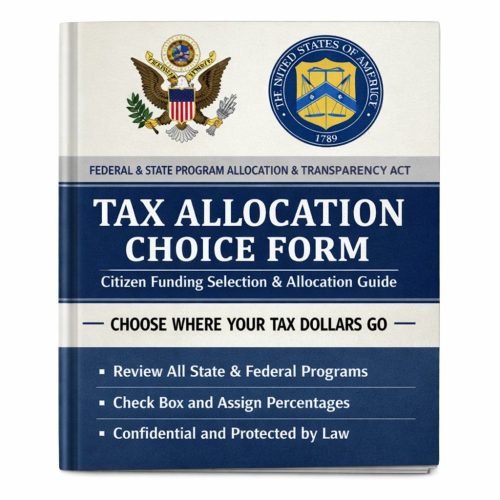
The policy, enacted under the Taxpayer Directed Allocation & Transparency Act, introduces a request-only system. Citizens who request the materials receive a printed catalog of government programs and a legally binding allocation form. Those who do not request it will continue funding programs selected on their behalf.
“This system does not remove choice,” said Senator Harold B. Whitcombe (R). “It simply requires initiative.”
The 25% That Is Already Decided
Under the new framework, 25% of all tax contributions are automatically reserved for the General Operations Allocation, covering:
- Law enforcement and emergency services
- Military baseline funding
- Administrative infrastructure
- Salaries and benefits for elected officials
“This portion is non-negotiable,” said Senator Marlene Ortiz (D). “Stability requires certainty.”
The remaining 75% becomes taxpayer-directed, to be distributed across state and federal programs at the individual’s discretion.
How You Actually Choose Where the Money Goes
The allocation process is intentionally simple.
Each program in the printed catalog appears on its own line, accompanied by:
- The program title
- A short, neutral description
- Current funding level
To the left of each program is a single checkbox.
To the right is a blank percentage field.
Taxpayers indicate participation by checking the box next to a program and writing the percentage of their 75% allocation they wish to assign to it. Percentages may be split across multiple programs, provided the total equals exactly 100% of the allocatable portion.
Unused percentages automatically revert to default distribution.
“There is no ranking,” explained Senator Douglas Renner (I). “There is only allocation.”
The Book That Makes It Personal
The government insists the printed format is essential.
“Digital interfaces create distance,” said Renner. “Ink creates accountability.”
The catalog, described internally as a Comprehensive Program Awareness Volume, lists hundreds of active programs, including those rarely mentioned publicly. Programs not selected by sufficient taxpayers may experience funding reevaluation during the next fiscal cycle.
A notice printed at the bottom of every page reads:
‘Unmarked programs receive no preferential treatment.’
Lobbyists May Advise, But Cannot Override
The legislation does not restrict lobbying efforts, though senators acknowledged their reduced effectiveness.
“Lobbyists may still attempt persuasion,” said Senator Whitcombe. “But they cannot check the box for you.”
All selections are protected by federal confidentiality law. Individual allocations are not visible to agencies, lawmakers, or outside organizations.
“This prevents influence correction,” said Ortiz. “Once you decide, the decision stands.”
What the Government Learns
Beyond funding redistribution, officials confirmed the program will generate detailed national preference data.
“For the first time, we’ll know what survives without momentum,” said Renner.
Programs that rely solely on default allocation will be clearly identified.
“That information,” Renner added, “will be useful.”
Optional Participation, Automatic Consent
Officials reiterated that participation is voluntary.
Taxpayers who take no action will see no interruption in services. Their money will continue flowing through established funding channels.
“The choice only exists for those who request it,” said a Treasury spokesperson. “Everyone else has already made theirs.”
When asked whether this system could permanently change public trust in government, Senator Whitcombe offered a brief response:
“We’ll see who reads the book.”
About the Author




 Jaime
Jaime 

 Kelly
Kelly