For nearly a decade, people have whispered about the simulation. You’ve heard it: “Nothing feels real anymore.” “NPCs are glitching.” “Why did that guy at the grocery store say ‘loading’ before answering me?”
But after reviewing a suspiciously thick stack of leaked documents, half‑redacted spreadsheets, and one USB drive labeled “Definitely Not Evidence”, our investigative team has reached a far more grounded conclusion:
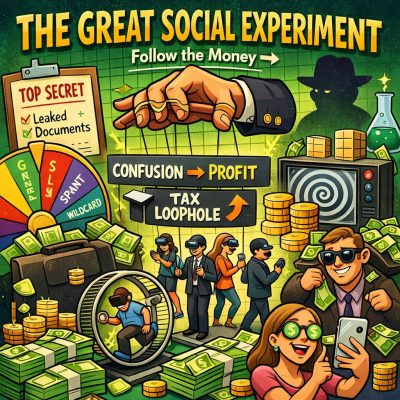
We’re not living in a simulation. We’re living in a seven‑year‑long social experiment funded by people who give away money just to avoid paying taxes.
And business is booming.
THE MONEY MUST MOVE, OR IT DIES
According to the fake-but-plausible “Circular Wealth Mobility Report” we obtained, ultra‑wealthy benefactors discovered a loophole around 2018:
If the money keeps moving, it can’t be taxed. If the money stops moving, it becomes “emotionally vulnerable” and subject to IRS attachment.
So what do you do when you have billions that must stay in motion like a shark that never sleeps?
You fund everything.
- Random social experiments
- Questionable “innovation labs”
- Influencer think tanks
- Startups that sell “air‑based hydration experiences”
- And of course, the classic: “community enrichment initiatives” that enrich everything except the community
The result? A seven‑year global improv show where everyone is unknowingly auditioning for grants they’ll never see.
EVERYONE IS CASHING IN — EXCEPT YOU
The leaked files show that the experiment’s architects—known internally as The Committee for Continuous Currency Circulation (CCCC)—have been quietly observing how society reacts when:
- Prices rise for no reason
- Apps change their UI weekly
- People get paid to do nothing
- People get paid to pretend they’re doing something
- People get paid to explain why other people are getting paid
One document, titled “Phase 3: Maximum Confusion Rollout,” outlines a plan to introduce contradictory trends every 48 hours to “maintain public disorientation and increase grant eligibility.”
Examples include:
- Encouraging minimalism while selling $900 minimalist starter kits
- Promoting digital detox retreats that require six apps to attend
- Funding research on why people don’t trust research
THE PUPPET MASTERS OF THE “SIMULATION”
People love to say, “We’re living in a simulation.” But our investigation suggests something far more chaotic:
We’re living in a simulation-themed social experiment run by people who think simulations are too expensive.
The puppet masters aren’t coders in a basement. They’re philanthropists with too much money, too many loopholes, and too much free time.
One leaked memo reads:
“If participants begin questioning reality, increase funding to the ‘Everything Is Fine’ initiative.”
Another says:
“If they start connecting the dots, release a new distraction trend. Preferably involving pets, snacks, or wearable technology.”
THE PAPER TRAIL WE FOUND
Our team uncovered:
- A 312‑page grant proposal for “studying the public’s reaction to being studied”
- A budget request for $48 million to “observe how people respond to unexpected free money”
- A flowchart titled “Confusion → Engagement → Revenue → Write‑off”
- A note scribbled in the margin: “If caught, claim it was performance art.”
We also found a spreadsheet listing “test subjects,” which appears to be… everyone. Literally everyone.
The final column simply reads: “Outcome: TBD.”
WHAT HAPPENS NEXT?
Based on the patterns we’ve seen, the next few years will likely bring:
- More experiments
- More money movement
- More “coincidences” that feel suspiciously coordinated
- More influencers pretending they discovered the truth
- More people saying “simulation” when they really mean “tax strategy”
And when the truth finally comes out?
They’ll probably get a polite letter, a stern eyebrow raise, and a wrist‑tap so gentle it qualifies as a spa treatment.
Because when you’re rich enough to fund reality, you’re rich enough to rewrite the consequences.
About the Author

 Jaime

 Kelly