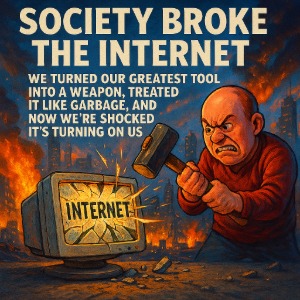
Society Broke the Internet: We Turned Our Greatest Tool Into a Weapon, Treated It Like Garbage, and Now We’re Shocked It’s Turning on Us
I. The Age of Caution: When the Internet Was a Strange Forest and We Were Told Not to Touch Anything
There was a time — a simpler, dial‑up‑screeching time — when universities taught students how to survive the digital wilderness with the seriousness of a survival course.
The rules were clear:
- Never share personal information with anyone
- Never give your real name to any website
- Never upload your face
- Learn safe browsing
- Learn how to properly look things up
- Use safe search engines — and AltaVista was the undisputed king
The internet was a frontier, and anonymity was your armor.
Age verification was a single checkbox:
“Are you 18?”
YES → Welcome, traveler.
II. The Oversharing Renaissance: Social Media Teaches Us to Do the Opposite
Then came MySpace, Facebook, and the era of “Tell us everything about yourself or you don’t exist.”
Platforms demanded:
- Your full legal name
- Your birthday
- Your hometown
- Your relationship status
- Your favorite movies
- A flattering headshot
- A biography revealing your entire life story
If you didn’t comply?
“Your profile is incomplete.”
We went from “protect your identity” to “broadcast your identity” in under a decade.
III. The Authenticity Crusade: Real Names Only, You Digital Peasant
Too many memes.
Too many satire sites.
Too many people pretending to be raccoons with Wi‑Fi.
Platforms declared:
“No more pseudonyms. No more avatars. No more fun.”
If you dared to keep your privacy, you were treated like a suspicious character in a crime drama.
Meanwhile, the same platforms leaked your data with the reliability of a toddler carrying soup.
IV. The Search Engine Purge: You Can’t Look That Up Anymore
Search engines decided the world needed less information.
Suddenly:
- Entire topics vanished
- “No results found” became normal
- The internet felt like a library where half the books were quietly burned
This pushed millions into the dark web — the last refuge where:
- You can still search anonymously
- You don’t have to hand over your ID
- And if you do give up your info, the consequences are worse than Brian hacking your IP from his unlocked Android phone
V. The Verification Era: Please Upload Your Government ID to Play a Video Game
The internet evolved from:
“Click to verify you’re 18.”
to
“Upload your passport, driver’s license, and retinal scan to continue.”
Major platforms suddenly needed government‑grade identification for you to:
- Play a game
- Post a meme
- Change your username
- Appeal a ban
Meanwhile, government websites still ran on Windows XP.
VI. The Doxing Era: Real Names, Real Consequences
Once everyone was trained to use their real identity online, the internet became a doxing buffet.
One wrong post and suddenly:
- Your address is trending
- Your employer is tagged
- Your childhood dentist is interviewed
- Your Amazon wishlist is subpoenaed
It’s almost like…
the push for “real identity online” wasn’t about safety at all.
VII. The “Protect the Users” Era: Age‑Gated Everything, IDs for Everyone
We now live in the era where every website believes it is a nightclub with a bouncer.
Content is divided into:
- 14+
- 16+
- 18+
- 21+
And each tier demands a government ID, a biometric scan, or a notarized letter from your parents.
The irony?
The people these systems are supposedly “protecting” are the ones most capable of bypassing them.
Meanwhile, adults still fall for:
“Your package is delayed. Click here to fix.”
VIII. The AI Era: Everything You’ve Ever Posted Is Now Training Data
AI systems now scrape:
- Every profile
- Every photo
- Every comment
- Every meme
- Every typo
- Every “I was just joking”
Your digital footprint is no longer a footprint.
It’s a body.
IX. The Future We’re Building: Social Credit, Western Edition
If we continue down this path, the next steps are obvious:
- Mandatory identity chips for logging into Netflix
- A universal Behavior Score based on your meme history
- Smart homes that lock you out for unapproved opinions
- AI moderators that scold you like disappointed parents
And the big one:
Under‑13 users needing government ID, proof of birth, and possibly a DNA cheek swab just to access a search bar.
Absurd?
Yes.
Which is exactly why it will happen.
X. The Final Question: Was This All By Design?
Let’s review:
- Don’t share anything
- Share everything
- Share everything truthfully
- Share everything with ID verification
- Share everything or lose access
- Everything becomes public and weaponized
- AI builds a version of you that may outlive you
- Search engines curate reality
- The dark web becomes the last refuge
- Age‑gating expands until toddlers need paperwork
We took the greatest tool humanity ever created, treated it like garbage, broke it, blamed it, and now we’re shocked it’s turning on us.
XI. Maybe It’s Time to Pull the Plug
If society can’t handle the tools it creates, maybe the tools shouldn’t be plugged in.
No computers.
No phones.
No charging issues.
No electric cars.
No algorithmic surveillance.
Just analog life.
Candles.
Paper.
Silence.
And the faint sound of a world rebooting itself the old‑fashioned way.
A hint, perhaps.
Or a warning.
About the Author



 Jaime
Jaime 
 Kelly
Kelly