
THE INVESTIGATIVE GUIDE TO SPOTTING FAKE POLITICIANS BEFORE THEY GET YOUR VOTE
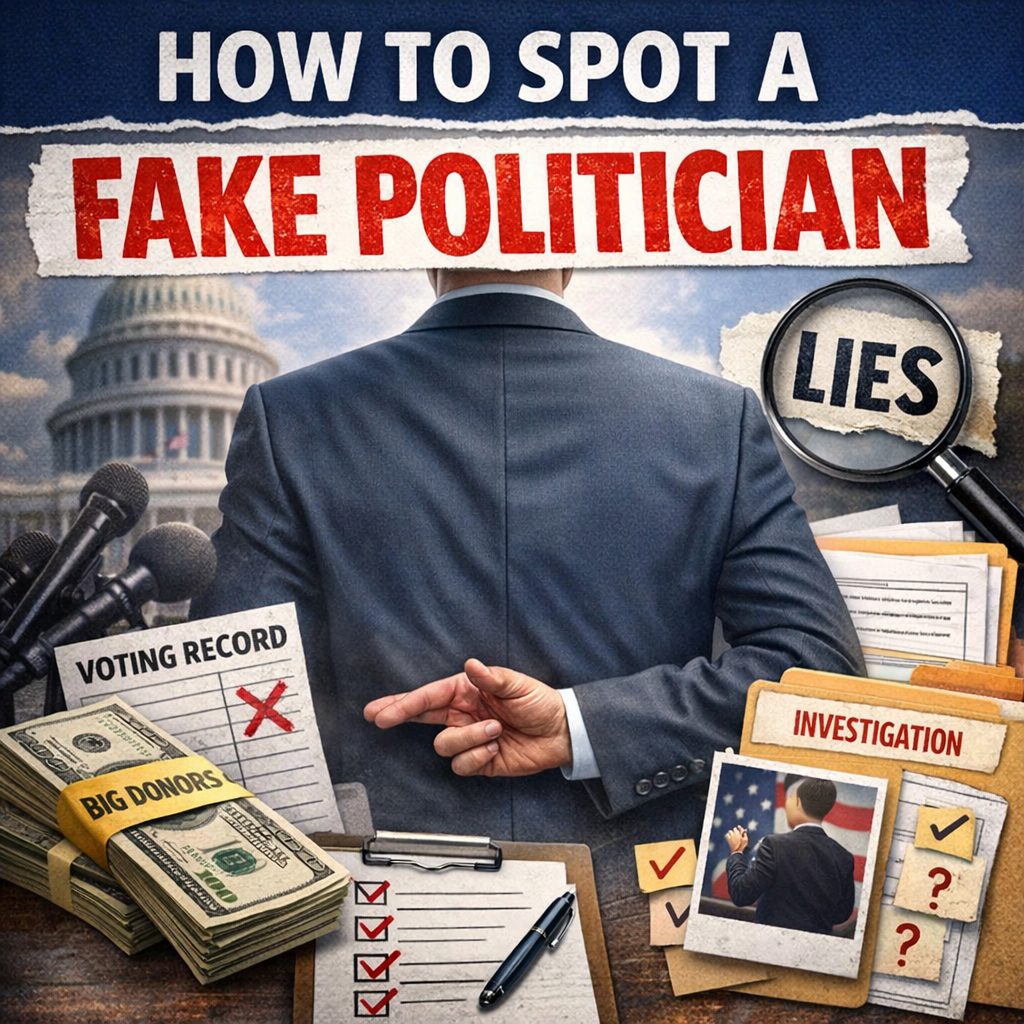
Every election cycle, a new wave of politicians emerges with polished smiles, perfect slogans, and the uncanny ability to promise everything except the truth. They shake hands, kiss babies, and insist they are “for the people,” even though the people have never seen them before and won’t see them again until the next election.
But here’s the good news: You don’t need money, influence, or insider connections to figure out who’s genuine and who’s performing a very expensive magic trick. You just need information, patterns, and the willingness to look past the campaign glitter.
This guide blends satire with real investigative techniques — because sometimes the best way to expose political nonsense is to laugh at it while dismantling it piece by piece.
1. FOLLOW THE FUNDING: THE REAL CAMPAIGN LANGUAGE
Campaign speeches are written by professionals. Campaign donations are written in plain English.
If you want to know what a politician truly values, look at:
- Who funds their campaign
- Which industries consistently support them
- Which PACs appear in their filings
- Whether their donors align with their public positions
Campaign finance records are public for a reason. They’re the closest thing to a politician’s actual diary.
If their funding sources contradict their slogans, trust the funding.
2. READ THEIR LEGISLATIVE RECORD (NOT THEIR SLOGANS)
A politician’s real identity isn’t found in their speeches — it’s found in:
- The bills they’ve drafted
- The bills they’ve co‑sponsored
- The bills they’ve quietly opposed
- The issues they only care about during election season
If their legislative record is thin, vague, or nonexistent, that’s a sign. If their record contradicts their campaign promises, that’s a bigger sign.
Legislation is the one part of politics that can’t be rewritten after the fact.
3. WATCH FOR THE “POLITICALLY CORRECT” DEFLECTION
When a politician says:
“I want to be politically correct about this…”
It often means:
- “I’m about to avoid your question.”
- “The truth is inconvenient.”
- “I’m hoping you’ll forget what you asked.”
Regular citizens don’t need to be politically correct to tell the truth. Politicians use it as a verbal smoke screen, a way to circle around a question until the question gets dizzy and gives up.
If you hear it, take notes — something important is being dodged.
4. COMPARE THEIR STATEMENTS OVER TIME
You don’t need to argue with a politician. You just need to compare their words to their other words.
Look at:
- Past interviews
- Old debates
- Archived campaign pages
- Public statements
- Social media posts
- Voting records
If their positions shift dramatically depending on the audience, the season, or the polling numbers, that’s not growth — that’s strategic shape‑shifting.
Screenshots are your best friend.
5. STUDY WHO THEY SURROUND THEMSELVES WITH
A politician’s inner circle reveals more than their speeches ever will.
Check:
- Their advisors
- Their long‑term allies
- Their donors
- Their consultants
- Their recurring collaborators
If their team is full of lobbyists, strategists, and people who use phrases like “optics management,” proceed with caution.
People rarely hire advisors who disagree with them.
6. WATCH HOW THEY HANDLE TOUGH QUESTIONS
A genuine politician answers tough questions directly. A fake one performs verbal gymnastics.
Common evasions include:
- Changing the subject
- Blaming the question
- Blaming the media
- Blaming “political correctness”
- Using 200 words to say nothing
- Smiling too confidently
- Responding with a story that has nothing to do with the question
If their answer requires a decoder ring, that’s a red flag.
7. USE PUBLIC RECORDS — THEY’RE FREE AND POWERFUL
You don’t need a budget to investigate a politician. You need:
- Public databases
- Voting records
- Ethics filings
- Local journalism
- Archived statements
- Community forums
- Public meeting minutes
Campaigns spend millions to shape an image. You can dismantle that image with five minutes of research.
8. RESEARCH THEM: FOLLOW THE MONEY, NOT THE SLOGANS
Before you vote, do a little detective work. You don’t need insider access — just a browser and curiosity. Here are legitimate, nonpartisan resources every citizen can use:
- Federal Election Commission (FEC.gov) https://www.fec.gov The official government database for campaign finance. Search candidates, committees, and donors to see who’s paying for the promises.
- OpenSecrets.org https://www.opensecrets.org Tracks campaign donations, lobbying activity, and “dark money.” Great for connecting industries to influence.
- VoteSmart.org https://www.votesmart.org Offers biographies, voting records, and issue positions. Compare what politicians say with what they actually do.
How to Use Them Together
- Start at FEC.gov — Identify major donors and committees.
- Cross‑check with OpenSecrets.org — See how those donors link to lobbying or corporate interests.
- Verify with VoteSmart.org — Match funding patterns to voting behavior and bill sponsorships.
These three sites form the citizen’s triangle of truth — free, factual, and immune to campaign spin.
THE SERIOUS‑SATIRE CHECKLIST: HOW TO SPOT A FAKE POLITICIAN
Use this before you vote:
□ 1. Who funds them?
If their donors contradict their message, trust the donors.
□ 2. What bills have they drafted or supported?
If their legislative record is empty or inconsistent, that’s a warning sign.
□ 3. Do they use “politically correct” to dodge questions?
If yes, something is being hidden.
□ 4. Do their past statements contradict their current ones?
Compare their words to their words.
□ 5. Who do they surround themselves with?
Advisors and donors reveal priorities.
□ 6. How do they handle tough questions?
Direct answers = confidence. Evasion = caution.
□ 7. Are they consistent when no one is watching?
Patterns matter more than promises.
□ 8. Does their public record match their campaign persona?
If not, the persona is the costume.
FINAL THOUGHT
You don’t need money to avoid fake politicians. You don’t need ads, consultants, or insider access.
You need:
- Curiosity
- Documentation
- Public records
- A willingness to look past slogans
- A refusal to be distracted by “politically correct” fog
Campaigns can spend millions to shape an image. But the truth is free — and it’s everywhere.
About the Author


 Jaime
Jaime 

 Kelly
Kelly