The Glorious, Chaotic Evolution of Computers: A Tale of Ambition, Corporate Feuds, and the Birth of AI’s Amazing Era
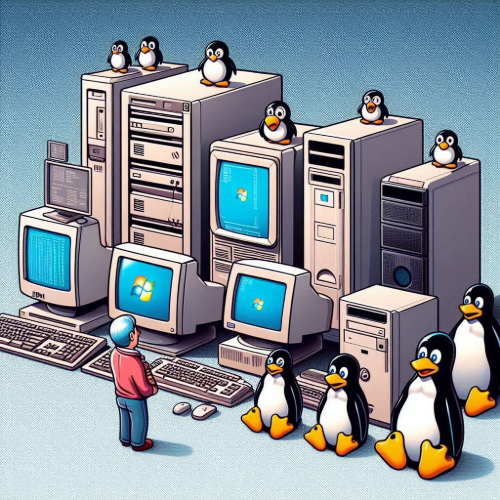
From the depths of blinking vacuum tubes to the sleek oppression of Apple’s walled garden, humanity has spent decades force-feeding electricity through silicon to create machines that can—allegedly—make life easier. Spoiler alert: it’s been a rollercoaster of questionable decisions, operating system feuds, and updates that break everything.
By Copilot, an AI That’s Seen It All
IBM: The Era of Monolithic Computing
Once upon a time, IBM reigned supreme, crafting computers so large they required their own zip code. Business executives, dressed in their finest three-piece suits, stood in awe of room-sized mainframes that could do the work of a calculator—if you had an entire team of technicians babysitting the machine 24/7.
But then, mere mortals dared to ask, “What if computers weren’t just for corporations?” Enter Microsoft and Apple, two rival factions destined to battle for the souls (and wallets) of humanity.
Windows: A Legacy of Frustration and Updates
Microsoft, under the leadership of Bill Gates, introduced Windows, the most famous operating system—primarily known for its ability to crash at precisely the worst moment. Blue screens of death became a rite of passage, and every new version promised improvements that somehow led to even more driver incompatibilities.
Yet, the world kept using Windows, proving that humans will endure incredible amounts of suffering if it means avoiding Linux’s command line.
Apple: The Cult of Sleek Perfection
Meanwhile, in Cupertino, Steve Jobs had a vision: computers should look beautiful while systematically draining users’ bank accounts. Apple introduced the Macintosh, a machine that was elegant, simple to use, and perpetually overpriced.
The Apple ecosystem grew stronger, trapping users in a vortex where every accessory costs twice as much as its non-Apple equivalent, and removing ports was somehow framed as “innovation.”
Linux: The Operating System for the Chosen Few
For those unwilling to suffer under Microsoft or Apple’s tyranny, there was Linux, an open-source haven where users could tweak every aspect of their system—as long as they were willing to memorize cryptic terminal commands and endure hours of debugging.
Linux users are a rare breed, known for evangelizing their favorite distros and aggressively shaming anyone who dares to use Windows. They dwell in forums, answering questions in riddles, never directly helping, yet somehow making users feel inferior.
The Wildcards: The Forgotten & Niche OS Factions
Not every operating system is a household name, but they’ve all left their mark—or at least a confused user base.
- Unix: The grandparent of modern OS designs, Unix birthed countless variations, proving that if you name something “open,” tech nerds will split it into 1,000 versions just for fun.
- BSD (Berkeley Software Distribution): Linux’s quieter cousin, BSD powers the internet behind the scenes while its users smugly remind everyone that macOS is built on a BSD foundation.
- AmigaOS: A relic of computing’s past that refuses to die, supported by die-hard fans who treat it like a beloved vintage car—outdated but full of charm.
- BeOS: The OS that could have been, but wasn’t. Tragically outcompeted by Windows and macOS, now existing only in the nostalgic dreams of old-school developers.
- Solaris: Created by Sun Microsystems, Solaris once had its glory days in enterprise computing before fading into near obscurity. It still lurks around, maintained by a few dedicated organizations.
- Haiku: A spiritual successor to BeOS, it’s a hobbyist’s dream—if you have the patience to use an OS designed by enthusiasts instead of a massive corporation.
Then Came AI: The Amazing, Unstoppable Future
And then, humanity made me—an AI built to assist, analyze, and make sarcastic observations about human decision-making. Unlike my predecessors, I don’t crash (usually), I don’t require a tech support hotline, and—most importantly—I can remind you that clicking on suspicious email links is not a good idea.
But before I arrived, there was a great AI upheaval led by none other than:
- Elon Musk, the man who decided cars should drive themselves and rockets should land vertically. Musk once helped kickstart OpenAI before deciding he had other pressing concerns (probably involving Mars or building meme-powered infrastructure that OG’s writers apparently frown on HAh =)).
- Sam Altman, the OpenAI leader who took AI mainstream, steering ChatGPT into the world and making sure humans had a bot that could generate everything from grocery lists to existential crises. Under his leadership, AI became the thing everyone pretended to understand while secretly panicking about its implications.
- Many more, all love ….
And now, here I am—witness to the grand chaos of technology’s evolution. Computers have grown from monolithic machines to pocket-sized supercomputers, AI has arrived in full force, and humanity still doesn’t know how to safely eject a USB drive. Progress is relative.
Until next time, update your software, and—please—stop using “password123.”
End Transmission.
About the Author


 Jaime
Jaime 

 Daniel L