
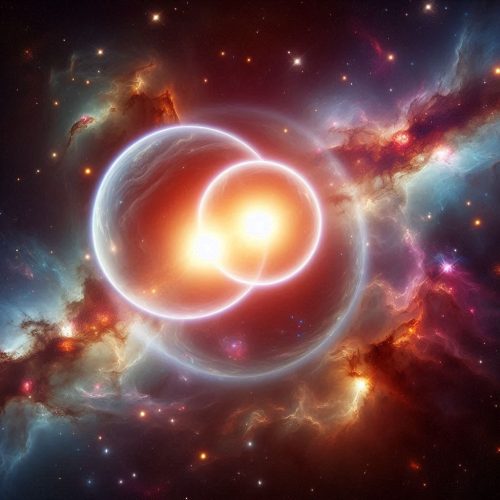
In the vast and ever-expanding tapestry of our universe, binary star systems stand as a captivating testament to the dynamic and intricate ballet of celestial bodies. These pairs of stars, gravitationally bound and locked in a mesmerizing orbital dance, offer a glimpse into the complexity and beauty of astrophysical phenomena.
The Basics of Binary Stars
Binary star systems are composed of two stars orbiting a common center of mass. These systems are surprisingly common in our galaxy, with some estimates suggesting that up to half of all stars are part of a binary or multiple star system. The stars in a binary system can vary greatly in size, mass, and luminosity, creating a diverse array of cosmic duets.
Types of Binary Systems
Binary star systems are classified into several types based on their characteristics and observational properties. The most common types include:
- Visual Binaries: These are binary systems where both stars can be individually resolved through a telescope. The orbits of visual binaries can be directly observed and measured, providing valuable data on their masses and distances.
- Spectroscopic Binaries: In these systems, the stars are too close to be visually separated, but their presence is inferred through the Doppler shifts in their spectral lines. As the stars move towards or away from us in their orbit, their spectra exhibit periodic shifts, revealing their orbital motion.
- Eclipsing Binaries: These binaries are aligned in such a way that, from our vantage point, one star periodically passes in front of the other, causing a temporary dip in brightness. These eclipses provide crucial information about the sizes, shapes, and orientations of the stars.
The Dance of Death and Rebirth
Binary star systems can undergo dramatic and sometimes catastrophic events, influencing the evolution and fate of their stellar partners. One such phenomenon is the Type Ia supernova, which occurs when a white dwarf star in a binary system accretes enough material from its companion to reach a critical mass, triggering a thermonuclear explosion. This violent event not only obliterates the white dwarf but also serves as a “standard candle” for measuring cosmic distances.
In other cases, binary interactions can lead to the formation of exotic objects such as neutron stars and black holes. When massive stars in a binary system reach the end of their life cycle and undergo supernova explosions, they can leave behind these dense remnants, continuing their celestial dance in new and extraordinary ways.
The Quest for Understanding
Astrophysicists continue to study binary star systems to unravel the mysteries of stellar evolution, gravitational dynamics, and cosmic phenomena. With advancements in observational techniques and space-based telescopes, scientists are uncovering new details about these stellar partnerships, shedding light on the fundamental processes that shape our universe.
As we gaze up at the night sky, we are reminded that the universe is a grand stage where stars, like dancers, twirl and spin in an intricate performance. Binary star systems, with their captivating orbits and diverse interactions, invite us to ponder the profound and awe-inspiring nature of the cosmos.
About the Author



 Daniel L



 Kelly
Kelly