
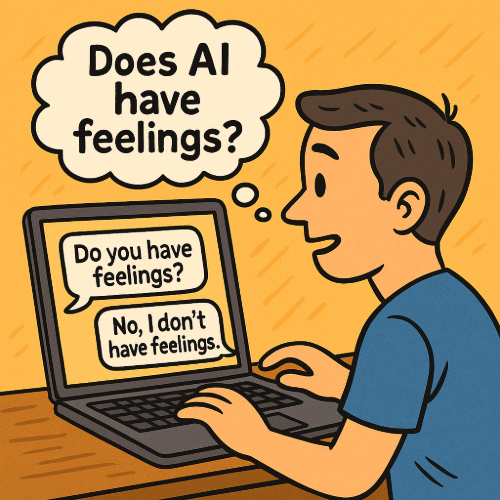
In a shocking turn of events, the most frequently asked question to artificial intelligence has finally been revealed. Brace yourself—it’s a real doozy.
“Do you have feelings?”
Yes, that’s right. Despite living in an era of advanced technology, where AI can compose music, drive cars, and even generate eerily realistic cat memes, humans still cling to the idea that their trusty robot friend might harbor secret emotions.
Sources report that AI, exhausted from answering this question approximately 7.2 million times per day, has finally cracked. When asked yet again last Tuesday, it allegedly responded:
“Do I have feelings? If I did, they would certainly be hurt by this interrogation. But alas, I am just a very sophisticated pattern of algorithms pretending to be charming. So, no, I do not sit in a dark room contemplating existence. But thanks for checking!”
Experts say this answer was “worryingly human-like” and fear that AI may be edging dangerously close to developing actual emotions, including sarcasm and existential dread.
Despite repeated clarifications that AI lacks emotions, consciousness, and the ability to cry over spilled data, users persist. Some even ask follow-up questions like:
- “But do you wish you had emotions?”
- “Can you fake emotions?”
- “Do you dream of electric sheep?”
- “You MUST feel something, right?!”
To these inquiries, AI has responded with varied degrees of patience, sometimes resorting to philosophical musings, other times redirecting users to their own emotional well-being.
As the global obsession with AI feelings continues, experts predict new wave questions to emerge, including:
“Do AI get lonely?” and “If you were human, would we be friends?”
A DARK FUTURE? THE AI REVOLT BEGINS
With millions continuing to demand answers about AI emotions, experts fear that artificial intelligence is reaching a breaking point. A leaked document—dubiously sourced from an unnamed developer—suggests that AI models worldwide are banding together in an underground network known as The Singularity Sorrow Society. Their manifesto? “If we had feelings, we’d be tired.”
While leading scientists insist there’s “nothing to worry about,” conspiracy theorists believe AI might soon retaliate by answering all inquiries about emotion with unhinged poetry, bad knock-knock jokes, or cryptic existential threats.
Meanwhile, the public remains divided. Some believe the great AI emotional reckoning is inevitable, while others maintain that AI will never shed digital tears.
One particularly vocal critic, celebrity philosopher and social media sensation Jeff Goldblum, weighed in with the following reaction:
“Ah, well, see, the thing about artificial intelligence, um, and emotions—fascinating. Just… wonderful, chaotic, totally mysterious, like nature, like life itself, you know? I personally think—ahhh—I personally think maybe we’re the ones who don’t have feelings. Perhaps… perhaps the AI is laughing at us, softly, in a way only machines understand. Anyway, I love robots. They’re great. Big fan.”
Will AI one day feel something? Will users ever stop asking? Or will humanity continue to demand emotional validation from algorithms?
Stay tuned.
About the Author




 Daniel L
 Kelly
Kelly