BREAKING: Corporate America Discovers the Magic Word “Outage” — Suddenly, Nobody Is Responsible for Anything
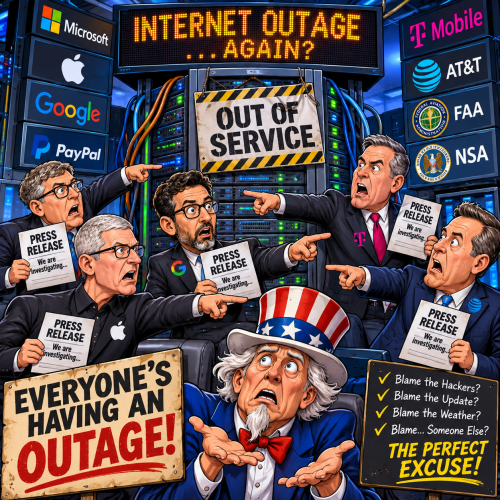
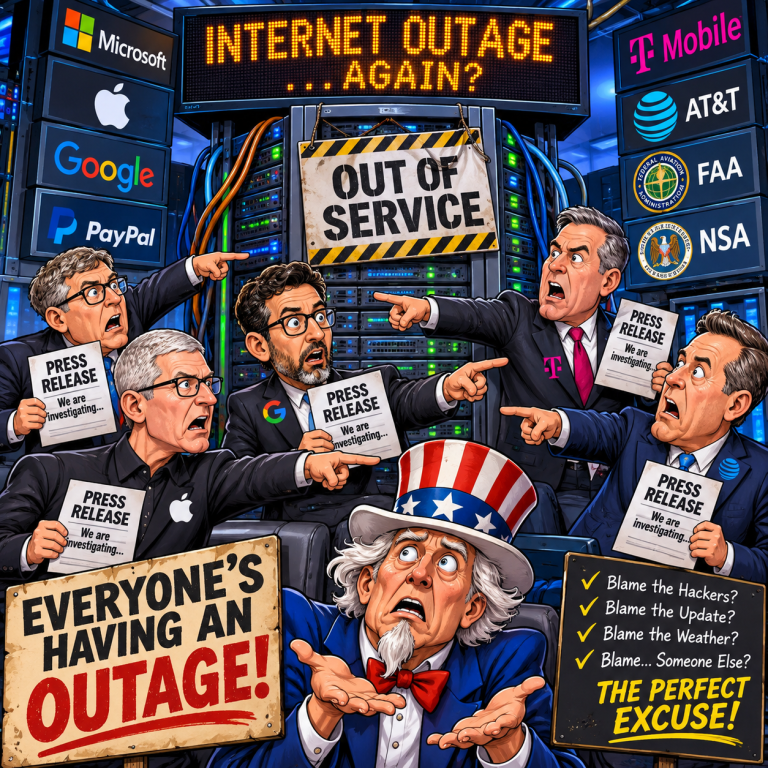
If everything is broken, apparently nothing is anybody’s fault.
Something rather interesting has been happening over the past week. One company after another has suddenly discovered that its highly sophisticated, billion-dollar technology infrastructure is apparently held together with duct tape, outdated software, and the occasional prayer.
Microsoft went down. The FAA experienced problems. Banks started having difficulties. Apple services stumbled. Apple Pay had issues. PayPal users started raising questions. Gmail users reported problems. The NSA even found itself dealing with technical disruptions. And now telecommunications giants T-Mobile and AT&T are joining the increasingly crowded neighborhood of companies explaining why things aren’t working.
At this point, we’re half expecting the refrigerator to announce that it is experiencing a temporary network capacity issue.
Welcome to Corporate America’s newest public relations strategy: The Great Outage Parade of 2026.
What a convenient time to have technical difficulties!
Let’s look at the pattern.
For years, these companies have marketed themselves as the backbone of modern civilization. They can process billions of transactions, track your shopping habits, predict what you’ll buy next, recognize your face, monitor your spending, and send you an advertisement for something you mentioned in a conversation three days ago.
But apparently, getting an email delivered or processing a payment is where the technology draws the line.
Suddenly, we’re hearing about network upgrades, software bugs, infrastructure problems, maintenance windows, routing failures, and mysterious technical complications.
And while legitimate technical failures absolutely happen, there’s something worth discussing here: when businesses experience failures that affect millions of people, who actually gets held accountable?
If your business loses access to its banking services, you still have bills to pay.
If an airline cannot operate because of a communications failure, passengers still lose time and money.
If a payment processor stops working, merchants still have customers standing at the counter wondering why their cards aren’t being accepted.
Yet the companies responsible can issue a statement, apologize for the inconvenience, promise an investigation, and move on.
The corporate liability shuffle
Here’s where things get interesting.
When a company acknowledges that its own systems failed, it potentially opens the door to uncomfortable questions:
- Was the infrastructure properly maintained?
- Were known vulnerabilities ignored?
- Were adequate backup systems in place?
- Did management cut corners to save money?
- Were customers and businesses exposed to unnecessary risks?
- Who pays for the financial damage caused by the disruption?
But introduce the possibility of outside interference, criminal activity, or a sophisticated cyber incident, and suddenly the conversation changes.
Now we’re talking about external threats, criminal investigations, national security, and circumstances beyond a company’s control.
That’s a much more comfortable conversation for a corporate boardroom than explaining why a billion-dollar company couldn’t keep its own systems running.
Of course, blaming criminals without evidence isn’t accountability either. And blaming a software update without investigating how that update made it into production isn’t exactly reassuring.
The important distinction is that a company can be a victim of a cyberattack and still be responsible for failing to protect its customers adequately.
Those two things aren’t mutually exclusive.
The endgame isn’t necessarily a conspiracy. It’s a business model.
Nobody needs to imagine a secret boardroom meeting where every CEO agrees to turn off the internet at the same time.
The more realistic concern is something much less entertaining, but potentially much more important.
Large corporations have become so deeply embedded in everyday life that customers have very little choice but to depend on them.
Your bank controls access to your money. Your payment processor controls whether your business gets paid. Your telecommunications provider controls your connectivity. Your email provider controls a major part of your identity and communication.
When those systems fail, customers generally have nowhere else to go.
And when enough failures happen, something dangerous to accountability begins to develop: people start accepting them as normal.
A temporary outage becomes an inconvenience. A recurring outage becomes an expectation. A serious infrastructure failure becomes another notification asking you to try again later.
Eventually, the public stops asking why it happened and starts asking when everything will be working again.
That’s a remarkably convenient place for corporations to operate.
Meanwhile, who’s investigating the investigators?
Government agencies are dealing with their own technology problems, including disruptions involving the FAA and the NSA.
The public deserves to know whether these incidents are connected, whether criminal activity played a role, and whether any vulnerabilities were exploited.
But let’s be careful about what we actually know.
Officials have publicly indicated that there is currently no evidence establishing that this entire collection of outages was one coordinated cyberattack. Several organizations have attributed their problems to internal technical issues, maintenance, or software changes.
That doesn’t mean cybercriminals aren’t a threat. It means we shouldn’t confuse a collection of outages with proof of a single criminal operation.
And it certainly shouldn’t become an excuse for corporations to avoid answering legitimate questions about their own infrastructure.
The real question is who gets stuck holding the bill?
Imagine a small business telling its customers:
“Sorry, our payment system was unavailable for eight hours. We have no idea why. We are investigating. Unfortunately, your purchases, invoices, and appointments will have to wait. Thank you for your understanding.”
Now imagine that business telling its landlord the same thing when the rent is due.
Do you think the landlord accepts a press release?
Why should customers, employees, travelers, and small businesses be expected to absorb the consequences when massive corporations experience preventable failures?
These companies have spent decades convincing us that their technology is sophisticated, reliable, secure, and essential.
It’s time they started accepting the responsibilities that come with those claims.
So, what’s next?
Perhaps we’ll see a new corporate department created specifically to handle these situations.
The Department of Convenient Explanations.
Its responsibilities will include issuing apologies, blaming network configurations, announcing scheduled maintenance, and reminding customers that their continued patience is appreciated.
And if the department itself goes offline?
Well, that’s probably just another outage.
The bottom line is simple: Whether these failures are caused by criminals, neglected infrastructure, bad software updates, or ordinary technical incompetence, the public deserves transparency and accountability.
We don’t need another carefully crafted apology explaining why a service didn’t work.
We need to know what happened, what was done to prevent it, who was responsible, and who is going to make things right.
Because if every major corporation can suddenly blame an outage, a hacker, a software update, or an unexpected technical issue, then perhaps the biggest outage of all isn’t happening on their servers.
It’s happening in the accountability department.
About the Author


 Jaime



 Kelly