THE ORGANIC DELUSION: A SATIRICAL, EDUCATIONAL SURVIVAL GUIDE FOR SHOPPERS WHO JUST WANT A DECENT TOMATO
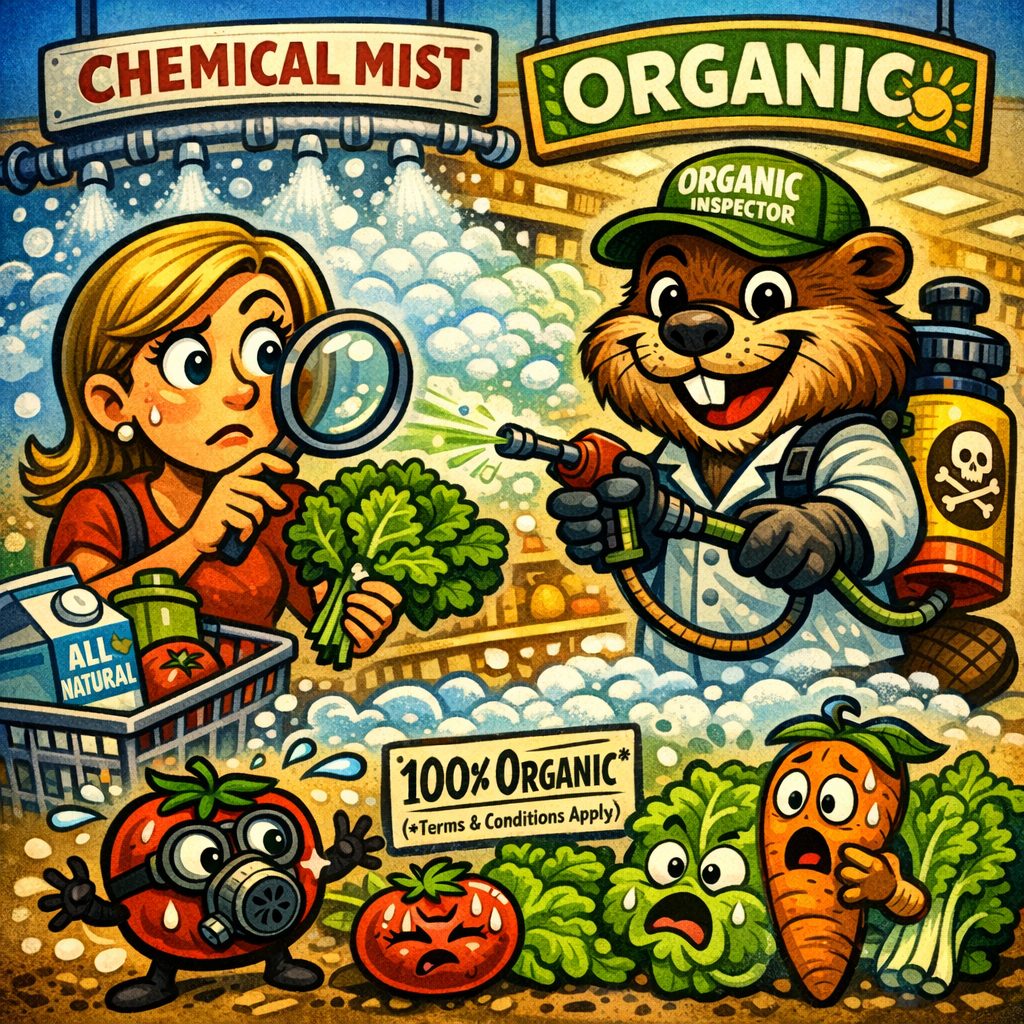
If you’ve ever stood in the produce aisle, staring at a $6 organic cucumber and thinking, “Wow, this must be the purest vegetable on Earth,” then congratulations — you’ve been spiritually mugged by marketing.
Because here’s the truth: Organic doesn’t mean chemical‑free. It means “chemicals we like.”
And if you’ve ever admired the gentle mist drifting over the produce section like a spa commercial for lettuce, you should know: That mist is not mountain spring water. It’s a chemical sanitation system.
Let’s break down the entire organic illusion — with humor, honesty, and just enough horror to make you rethink your kale.
🧪 1. WHAT “ORGANIC” ACTUALLY MEANS (AND DOESN’T MEAN)
Most people assume “organic” means:
- No pesticides
- No chemicals
- No toxins
- No bad vibes
Reality check: Organic farms use pesticides — lots of them. They just have to be “natural,” which is a word that means absolutely nothing except “came from something alive at some point.”
Here are some approved organic pesticides:
- Copper sulfate — toxic to humans and aquatic life in high amounts
- Pyrethrin — a natural neurotoxin
- Spinosad — can kill bees if misused
- Sulfur — irritant, but “natural,” so it gets a free pass
Meanwhile, some synthetic pesticides that are less toxic? Banned. Because they’re not “natural.”
This is the equivalent of banning seatbelts because they’re man‑made, but allowing “natural” bear attacks.
💦 2. THE GROCERY STORE MISTER SYSTEM: THE ORGANIC GOLDEN SHOWER
You know that mist that sprays your lettuce every 30 seconds?
The one that makes you feel like you’re in a rainforest commercial narrated by David Attenborough?
Yeah… that’s not water.
Grocery store misters are hooked up to chemical sanitation systems designed to:
- prevent mold
- kill bacteria
- stop rot
- keep produce looking “fresh”
- and maintain the illusion that your lettuce was harvested by woodland elves
The system uses treated water, filters, and antimicrobial agents — because if they used plain tap water, your organic spinach would look like a Victorian orphan by noon.
Irony level: 10/10 The only produce guaranteed to get a daily chemical shower is the one labeled “organic.”
Satire headline: “Organic Kale Receives More Sanitizing Chemicals Than a Hospital Bed, Still Costs $3 Extra for Purity.”
🌍 3. GLOBAL ORGANIC LABELING: A CHAOTIC WORLD TOUR
Every country treats “organic” like a different religion:
🇪🇺 European Union
Stricter rules, but still allows natural pesticides. Also loves numbering everything like it’s a robot factory.
🇺🇸 United States
Looser rules, more marketing freedom, and a certification process that’s basically a paperwork obstacle course.
🇦🇺 Australia
Has multiple competing organic standards because apparently one wasn’t confusing enough.
🇯🇵 Japan
Allows some synthetic inputs if they’re “traditional,” which is the most Japanese loophole imaginable.
🇨🇦 Canada
Same as the U.S., but with more politeness and fewer lawsuits.
Satire headline: “International Organic Standards Now Determined by Vibes, Moon Phases, and Whatever the Inspector Had for Breakfast.”
🧠 4. NATURAL VS. SAFE: THE GREAT MISUNDERSTANDING
Here’s the part most people never hear:
- Natural ≠ safe
- Synthetic ≠ dangerous
- Organic ≠ chemical‑free
- Conventional ≠ poison
Hemlock is natural. Rattlesnake venom is natural. Volcanoes are natural. Beaver butt secretions used as vanilla flavoring? Also natural.
Meanwhile, synthetic vitamins, lab‑purified molecules, and modern pesticides can be safer than their natural counterparts.
But the organic label doesn’t care about safety. It cares about origin stories.
If it sounds like it could be harvested by a druid under a full moon, it’s organic.
📜 5. WHY THE ORGANIC LABEL EXISTS (AND WHY IT’S CONFUSING)
The organic label was originally meant to:
- reduce environmental impact
- encourage sustainable farming
- limit synthetic inputs
- promote soil health
But over time, it became:
- a marketing tool
- a status symbol
- a $60 billion industry
- a way to charge $7 for a tomato
And because the rules vary wildly by country, the label is more about bureaucracy than purity.
Organic certification is basically a Hogwarts sorting hat for vegetables — arbitrary, dramatic, and occasionally wrong.
🛒 6. SO WHAT SHOULD PEOPLE ACTUALLY KNOW?
Here’s the real educational payoff:
Organic produce is not chemical‑free.
It uses approved natural pesticides.
Conventional produce is not poison.
It uses regulated synthetic pesticides with strict safety limits.
Grocery store misters use sanitation chemicals.
Because produce is gross and full of microbes.
Organic certification varies by country.
There is no universal standard.
The word “natural” is meaningless.
It’s a marketing term, not a scientific one.
The safest produce is the one you wash.
Regardless of label.
🎉 CONCLUSION: ORGANIC IS A FEELING, NOT A FACT
At the end of the day, the organic label is:
- part science
- part marketing
- part mythology
- part bureaucratic improv comedy
But if this article helps even one shopper understand what “organic” actually means, then we’ve done our job.
And if not? Well, at least now you know your organic lettuce is getting a daily chemical spa treatment — and honestly, it deserves it.
About the Author

 Daniel L

 Kelly
Kelly