FDA Expands Definition of “Natural Ingredients,” Public Wonders If Anything Is Real Anymore
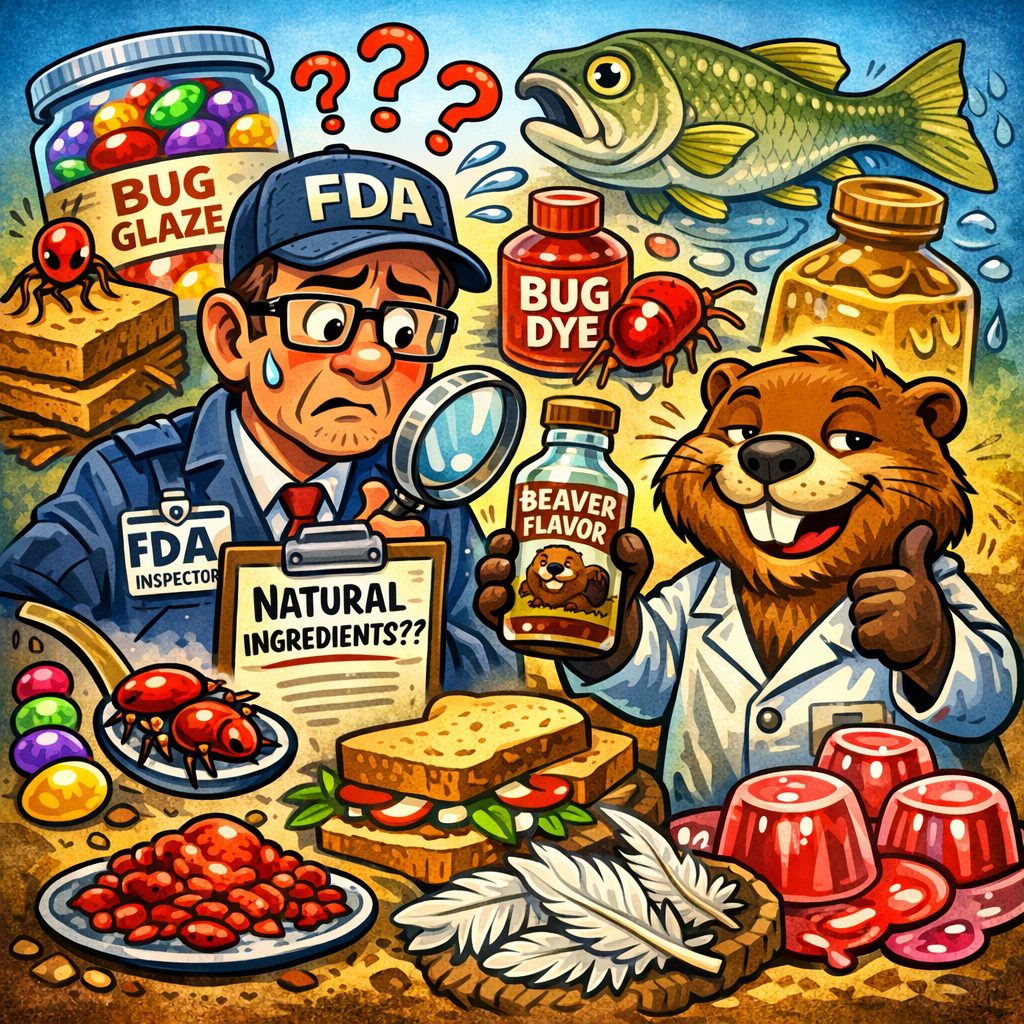
In a bold move to reassure absolutely no one, the FDA has once again clarified that “natural ingredients” may include anything that has ever touched, been near, or been secreted by a living organism. This announcement comes after renewed public concern that castoreum — the vanilla‑scented secretion from a beaver’s backside — can legally be labeled as a “natural flavor.”
Consumers responded with a mix of horror, confusion, and a surprising number of people saying, “Honestly, I’ve had worse.”
But castoreum is only the tip of the iceberg lettuce. Dirt‑In‑A‑Bottle has uncovered six other legally‑allowed, eyebrow‑raising substances that can be tucked neatly under the “natural” umbrella in the United States — while other countries either ban them, label them differently, or pretend they don’t exist.
Below is our investigative roundup of the FDA’s most creative interpretations of “natural.”
1. Beaver Castoreum: The Poster Child of Natural Confusion
The FDA maintains that castoreum is perfectly safe and can be listed as “natural flavor,” because it comes from a real animal and not, say, a 3D printer.
Other countries?
- EU: Requires explicit labeling.
- Canada: Allows it, but politely.
- Australia: Pretends it’s never heard of it.
American consumers, meanwhile, are left wondering if their vanilla yogurt is lying to them.
2. Shellac: The Bug-Polish Glaze on Your Candy
Shellac, also known as “confectioner’s glaze,” is made from the secretions of the female lac bug. It gives candies, pills, and fruit that shiny, “I’m fresh, I promise” look.
FDA label: “Natural glaze.” EU label: “E904 — insect resin.” Public reaction: “Wait… my Skittles are shellacked?”
One parent told us, “I thought the shine meant quality. Turns out it meant bugs.”
3. Carmine: The Red Dye Made From Crushed Beetles
Carmine, also known as cochineal extract, is a vibrant red pigment made by grinding up thousands of tiny insects.
FDA label: “Carmine” or “cochineal extract.” EU label: “E120 — insect-based colorant.” Vegan reaction: screaming intensifies.
The FDA insists it’s natural because “bugs are natural,” which is technically true but spiritually upsetting.
4. Isinglass: Fish Bladder Beer Clarifier
Isinglass is a gelatin-like substance derived from dried fish swim bladders, used to clarify beer and wine.
FDA label: Not required at all. EU label: Must disclose allergens. UK label: “May contain fish products,” which is the understatement of the century.
One Arizona man told us, “I’ve been pescatarian for 12 years. Turns out I’ve been beer‑tarian too.”
5. L‑Cysteine: Dough Conditioner Made From Human Hair or Duck Feathers
This amino acid is used to soften bread dough and extend shelf life. It can be derived from:
- human hair (often from barbershops overseas)
- duck feathers
- or, in rare cases, synthetic sources
FDA label: “L‑Cysteine.” EU label: Must disclose if animal‑derived. China: “It’s fine. Don’t ask questions.”
American consumers: “So my croissant is… feather‑fluffy?”
6. Rennet: Cheese Coagulated With Baby Cow Stomach Enzymes
Traditional rennet comes from the stomach lining of young calves. It’s used to curdle milk into cheese.
FDA label: “Enzymes.” EU label: Must specify animal or microbial source. Italy: “If it’s not calf rennet, it’s not cheese.”
Vegans everywhere: “We knew cheese was evil, but not this evil.”
7. Gelatin: The Great Mystery Goo
Gelatin is made by boiling the skin, bones, and connective tissues of pigs or cows until they surrender their structural integrity.
FDA label: “Gelatin.” EU label: Same, but with more existential dread. France: “Oui, it is natural. Bon appétit.”
Used in:
- marshmallows
- gummy bears
- Jell‑O
- anything that wiggles ominously
One consumer told us, “I thought gelatin was plant-based. I was wrong. So wrong.”
Why Does the FDA Allow All This?
According to the FDA, “natural” simply means the ingredient originated from a plant or animal and wasn’t chemically synthesized in a lab.
Which means:
- beaver glands = natural
- bug resin = natural
- fish bladders = natural
- crushed beetles = natural
- feathers = natural
- cow stomach enzymes = natural
Meanwhile, a lab‑made vanilla identical to the molecule found in nature? Not natural.
The FDA declined to comment, citing “lunch break.”
Global Labeling Chaos
Different countries handle these ingredients differently:
- EU: Loves numbering things (E120, E904, etc.) and making you Google them.
- UK: Labels allergens but not existential crises.
- Japan: Bans some insect colorants but allows others.
- USA: Shrugs and says, “It’s natural, don’t worry about it.”
One international food scientist told us, “If you want transparency, move to the EU. If you want plausible deniability, stay in America.”
Conclusion: Everything Is Natural If You Try Hard Enough
At the end of the day, the FDA’s definition of “natural” is so broad it could probably include:
- a rock
- a cloud
- a beaver’s tax returns
- your hopes and dreams
But hey — at least your vanilla ice cream probably doesn’t contain beaver secretions anymore. Probably.
About the Author


 Jaime
Jaime 
 Daniel L