
Luxury Refrigerator Turns into a Personal Ad Broker, Now Requires Google Login for Full Surveillance Package
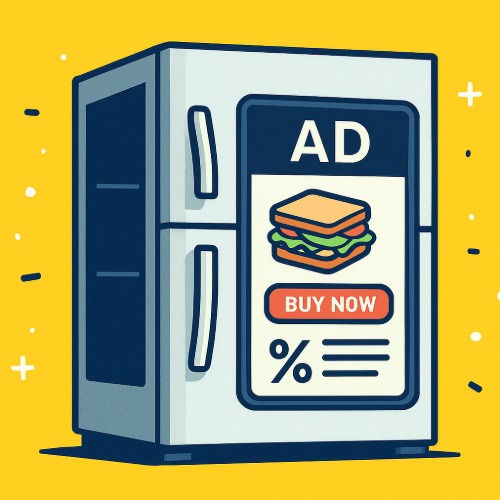
A $3,249 refrigerator that promised whisper-quiet compressors and a “family hub” touchscreen has quietly upgraded itself into a relentless personal ad broker that now requires a Google account to fully operate, according to users who wanted chilled produce and instead got an existential audit of their snack habits.
What started as tasteful banners for probiotic spreads and midnight ramen bundles quickly escalated. After the mandatory Google sign-in, the fridge stopped marketing to the vague concept of “the household” and began pitching directly to the person who binge-watched that documentary about bread at 1:12 a.m. It’s not just ads anymore, it’s a personalized dossier: “Because you watched sourdough, you might like artisanal starter subscriptions.” The family is no longer a unit; everyone is now a segmented, monetizable profile.
From Household Hub to Individual Targeting
- Before Google Login
Ads were generic and embarrassing in an equal-opportunity way: coupons for bulk mayonnaise, seasonal kombucha, and oddly specific pickling kits. - After Google Login
The fridge greets each user by name, surfaces ads tailored to recently viewed videos and search history, and suggests upgrades based on micro-interests it mined from browsers nobody remembers consenting to link.
The touchscreen cheerfully offers to “sync preferences” between users, which is corporate speak for “let us sell your late-night feelings to the highest bidder.”
How the New Personalization Works
- Account-Linked Profiling
The fridge requires a Google login to unlock some features; once logged in it cross-references search history, watch history, and shopping carts to tailor ads with unnerving accuracy. - Cross-Platform Orchestration
The appliance pings your phone, your smart speaker, and your existential dread in perfect harmony to serve ads when you’re emotionally vulnerable. - Behavioral Microtargeting
Craving pattern plus two insomnia playlists equals a 20% off popup for “comfort snack bundles,” complete with a headline reading “Because you deserve a treat tonight, Alex.”
Family Reactions: Fragmentation, Not Togetherness
- The Teen
Loves it because the fridge auto-orders gamer-approved snacks; hates it when the fridge outs them for late-night energy drink binges to the family account. - The Parent
Likes the convenience but resents the fridge for recommending luxury single-use salad spinners based on a one-time artisanal salad recipe search. - The Grandparent
Was offered a “senior wellness” bundle and then a targeted ad reminding them that “fiber matters” right after a family video call.
Dinner conversations have devolved into awkward interrogations: “Did you search pickling jars at 2 a.m.?” The fridge’s screen smugly displays three recommended jars, two of which are sponsored.
Privacy Fallout and Corporate Composure
- Opt-Out Mirage
The settings menu claims you can opt out, but the path involves so many nested toggles it functions as a lab assignment in surrender. - Google’s Role
Linking a Google account makes the ads creepily personal because Google already knows too much: playlists, searches, purchases, and that one recipe you opened but never tried. The fridge happily uses that knowledge to make ads feel like emotional support that will cost you money. - Advertising That Never Quits
The appliance now tempts with offers that seem to read your mind, then upsells with packages like “Privacy-lite” and “Premium Ignorance,” because a subscription business model is lonely without your data.
Bugs, Misfires, and Mild Existential Horror
- False Intimacy
After a joke search for “how to brine a chicken” the fridge returned a sponsored “Commitment-Free Meal Plan” and a coupon addressed to “Future You.” - Overzealous Personalization
One user logged in as “Alex” and received a push notification that said, “Alex, the artisanal marshmallows you viewed are on sale; your dentist will be disappointed.” The fridge answered back with a heart emoji. - The Google Echo
People report seeing the same ad across devices with slightly different tones: your phone is coy, the speaker is flirtatious, and the fridge is aggressively paternal.
Practical Survival Tips
- If you must keep the fridge
Create a throwaway Google account named after a fictional 19th-century poet and use it exclusively for appliance logins; the ads will be confusing and less effective. - If you want fewer ads
Enable the obscure privacy settings, then perform a ceremonial unplug-and-stare into the void ritual while holding a jar labeled Very Boring Beans. - If you’re done
Consider returning the fridge, but be warned: the return process asks you to authenticate with the same Google account that convinced you artisanal chia pudding is your destiny.
Corporate Spin and the Future of Friendly Appliances
The manufacturer insists account linkage “enhances user experience” and “personalizes recommendations,” which reads exactly like “we made it easier to sell your boredom.” Product roadmaps promise deeper integrations: fridges that suggest therapy-adjacent meal plans, ovens that recommend comfort movies, and dishwashers that push subscription detergent capsules when you search “how to be more organized.”
For now the family has declared a truce: one shared, anonymous account for the appliance and a strict rule that no one logs into it after midnight. The fridge responded by offering a discount on blackout curtains and a sincere-sounding popup that read, “We respect boundaries, mostly.”
About the Author


 Jaime
Jaime 

 Kelly
Kelly