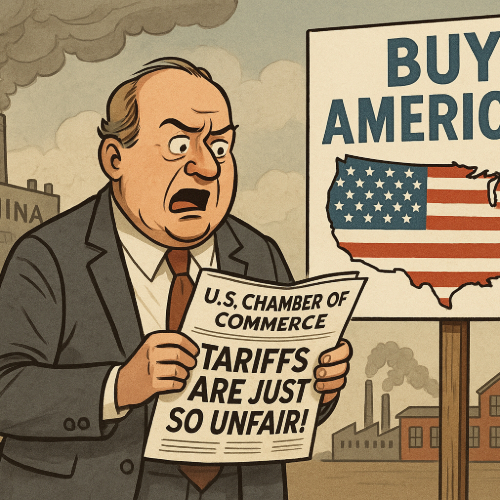
In a twist that would amuse any budding satirist, our very own U.S. Chambers of Commerce have taken up a new hobby: penning lamentations on tariffs in their members’ newsletters. Rather than championing the noble call of “Don’t buy from China—Make it in America!”, they prefer to broadcast their grievances like a broken record on the woes of imported goods. Who knew that complaining could become an art form so refined that even the most mundane tariff dispute transforms into an operatic tragedy?
One might wonder, “Where did all the patriotic fervor go?” Instead of urging businesses to invest in American manufacturing and support local industry, the Chambers have opted for melodrama. Their newsletters read like a series of pity parties, where the only solution offered is a hearty groan and a resigned sigh over the cost of doing business. Meanwhile, the forgotten heroes of American industry are left twiddling their thumbs, wondering when someone will finally put on a show of support for the hardworking men and women reviving our domestic production.
Let’s not beat around the bush—there is a backup plan that seems to have been overlooked entirely: supply and demand. It’s a concept as old as time (and as simple as gravity). When you buy less of those Chinese-made products, the demand naturally tapers off. Prices decline, offsetting the tariffs by the same percentage. In other words, if we simply stop whining and start buying American, we would be hitting the economic reset button with one decisive click. This strategy not only bolsters our economy but also swings the spotlight on U.S. manufacturing as the backbone of a resilient, sustainable future.
Meanwhile, over in factories abroad, manufacturing often occurs in unregulated conditions—where environmental safeguards and labor rights are about as present as hope in a Shakespearean tragedy. Instead of casting a critical eye on these international issues, our domestic policymakers and lobbyists seem content to point fingers at tariffs. With all the clamor from the “save the planet” brigade in America, it’s almost as if we’d rather bemoan the effects of external policies instead of confronting the grim realities of unfettered production overseas. Perhaps a bit of introspection and a call for stricter environmental standards in global manufacturing would serve us better than another tariff debate.
The irony here is palpable. When the chambers could be articulating a robust vision of American industry—an inspiring blueprint for a future where the “Made in USA” label dominates store shelves—they instead choose to amplify a narrative of woe. It’s a narrative that distracts from the reality that by simply altering our spending habits, we can leverage supply and demand to our advantage, support local jobs, and recalibrate our economic priorities. After all, every dollar spent domestically is a vote for an America that values resilience over reliance on imports.
So, let us put an end to the moaning about tariffs. Let’s roll up our sleeves, demand quality goods made by American hands, and resuscitate our economy one purchase at a time. It’s time for our Chambers of Commerce to trade their complaint columns for manifestos that inspire innovation, production, and a firmly rooted national pride—a national pride that comes not from lamenting challenges, but from boldly overcoming them.
Who’s ready to buy America?
About the Author


 Kelly
Kelly 
 Daniel L