New Consumer Bandwidth Restitution Bill Demands Tech Giants Pay Back “Stolen Internet Packets”
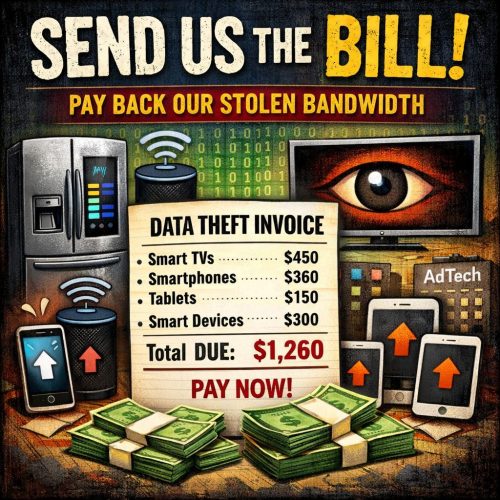
WASHINGTON, D.C. — A newly proposed consumer protection bill aims to do what no privacy policy has ever dared to do: attach a price tag to every digital breath corporations take inside your home.
Dubbed the Consumer Bandwidth Restitution Act (CBRA), the bill argues that internet access is not free, bandwidth is finite, and every packet siphoned off to advertisers, analytics firms, and “trusted partners” is, by definition, theft.
“People keep acting like the internet is some magical, infinite cloud,” said Senator Harold D. Renshaw (D–Somewhere), reading solemnly from a stack of printed TCP/IP diagrams. “But packets cost money. They always have. And somebody is paying for them. Spoiler alert: it’s not Google.”
The Core Argument: You Paid for the Screen, Not the Surveillance
According to the bill’s language, consumers purchase devices, televisions, phones, and appliances under the assumption that their internet service is being used to deliver content, not to silently export behavioral dossiers.
“I paid for the TV,” said one frustrated homeowner quoted in the bill’s preamble. “I did not authorize my refrigerator to gossip about my eating habits with 14 marketing firms in Nevada.”
Under CBRA, any company transmitting user data without explicit per-packet compensation would be required to reimburse consumers for the bandwidth consumed, plus penalties for what lawmakers are calling “non-consensual packet appropriation.”
A Look at the Average Household Bandwidth Heist
The bill includes a surprisingly detailed estimate of how much data an average family is allegedly losing to background surveillance.
Typical household inventory:
- 4 Smart TVs
- 4 Smartphones
- 2 Tablets
- 1 Smart Refrigerator
- 2 Alexa devices
- 2 Google Home devices
- 12 Smart lights and switches
Estimated background data usage per device (conservative):
- Smart TV: ~1.5 GB/day (ads, telemetry, viewing analytics)
- Smartphone: ~500 MB/day (app tracking, location pings)
- Tablet: ~300 MB/day
- Smart fridge: ~50 MB/day (yes, really)
- Voice assistants: ~200 MB/day each
- Smart lights: ~10 MB/day each (status updates, cloud sync)
Total estimated passive data leakage:
➡ ~12–15 GB per day
➡ ~450 GB per month
➡ ~5.4 TB per year
That’s data the bill claims is not serving the consumer, but instead enriching third parties.
At current average internet costs, lawmakers estimate consumers are unknowingly paying $120–$300 per year just to transmit their own behavioral exhaust back to corporations.
“That’s Not Telemetry. That’s Pickpocketing.”
The bill draws a historical comparison to early internet service, when users were allocated strict bandwidth caps and charged per megabyte.
“Back then, if you sent too much data, your connection slowed to a crawl,” said Rep. Linda Morales. “Now corporations send more data than ever and pretend it’s invisible. It’s not invisible. It’s just externalized.”
CBRA proposes that companies be billed retroactively for:
- Unauthorized data packets
- Behavioral profiling uploads
- Background advertising telemetry
- Device-to-cloud ‘heartbeat’ signals unrelated to core functionality
The Refund Plan: Operation Packet Payback
The proposed restitution strategy is simple, if ambitious:
- Audit outgoing household traffic
- Attribute packets to corporate endpoints
- Invoice companies at ISP-equivalent rates
- Apply a 30 percent “involuntary bandwidth usage” surcharge
- Issue consumer refunds or tax credits
A preliminary estimate included in the bill suggests that U.S. households could be owed $48 billion collectively over the past decade.
Tech lobbyists have already dismissed the proposal as “confusing,” “anti-innovation,” and “mathematically inconvenient.”
Final Thought: If It Costs Money, It Isn’t Free
The bill ends with a blunt reminder:
“If a company takes your data, it takes your bandwidth.
If it takes your bandwidth, it takes your money.
And if it does that without permission, it isn’t analytics.
It’s theft.”
Whether the Consumer Bandwidth Restitution Act passes or quietly vanishes into committee purgatory, one thing is clear: the age of pretending packets are free may finally be buffering.
About the Author


 Jaime
Jaime 
 Kelly
Kelly