
“Flags at Half-Mast: Confusion Reigns as Church and State Continue Their Dance”
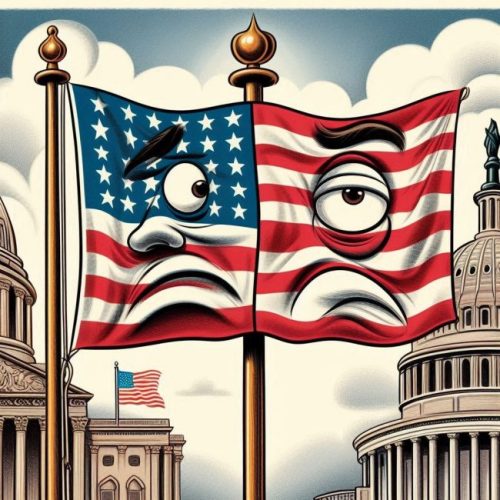
In an era where flags seem to spend more time at half-mast than flying proudly at full, Americans are once again perplexed by the latest reason for lowering Old Glory. This time, the order was issued to honor the passing of a prominent religious leader. The decision has sparked a flurry of conversations—some respectful, others irreverent—about the relationship between church and state, and how closely the two should tango when it comes to national mourning.
For the uninitiated, “church and state” refers to the relationship between religious institutions and the government or secular state. The phrase often implies the principle of separation of church and state, which advocates for keeping religious organizations and the government from interfering in each other’s functions. It’s a tidy principle, neatly boxed—until a public decision like this comes along and the lines start to blur.
“I thought we kept church and state separate,” mused Jerry Feldman, an assistant librarian in Boise, Idaho, “or at least on opposite sides of the flagpole. Now the flag’s doing downward dog at half-mast and everyone’s asking why.”
Critics argue the move is contrary to the principle of separation, contending that the government’s acknowledgment of a religious figure’s passing could set a precedent for intertwined spheres of influence. Others defend the gesture, emphasizing the deceased’s contributions to peace and global compassion, which they claim transcended religious boundaries. “It’s about unity,” said Marsha Graham, a local community organizer. “But unity based on whose definition? When one figure is honored, others inevitably feel left out.”
Meanwhile, the National Flagpole Association has stepped in to address the chaos. The organization has issued an urgent call for clarity through its proposed publication Half-Mast Guidelines for Dummies. The guide promises to establish clear criteria for lowering flags, outlining distinctions between national, secular, and religious significance. “We’re not saying we shouldn’t honor great people,” clarified Patty Pole (no relation), spokesperson for the association. “But when the government orders the flags down for someone tied to religion, it gets messy. This is precisely why the principle of church and state exists: to prevent decisions that muddle personal faith and public policy.”
As social media buzzes with memes, debates, and petitions calling for equal mast-time, the flag itself appears more confused than patriotic, caught in its own identity crisis. As Americans look upward—partly in honor, partly in puzzlement—one thing is certain: the dance between church and state continues, and the humble flag remains its accidental dance partner.
About the Author




 Jaime
Jaime 

 Kelly
Kelly